Featured

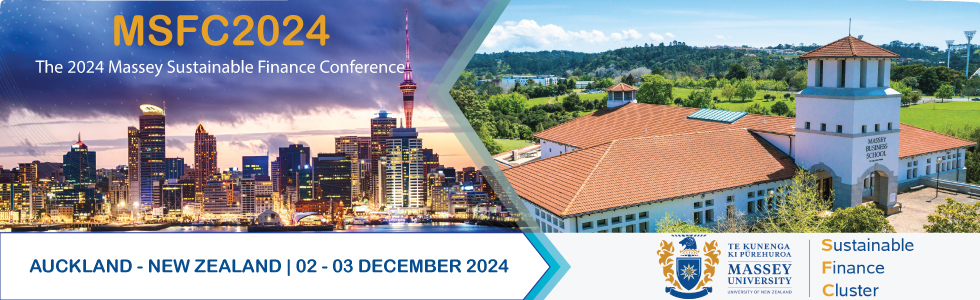
Massey Sustainable Finance Conference 2024

02 – 03 December 2024 | Auckland, New Zealand

The conference cordially invites scholars to submit research papers for presentation consideration at the 2024 Massey Sustainable Finance Conference that will take place on 02-03 December 2024 in Auckland, New Zealand. The conference allows both online and in-person presentations.

This conference, organized by the Massey Sustainable Finance Cluster at School of Economics and FinanceMassey University, aims to bring together academics, practitioners, and policymakers sharing their research findings and discussing current and challenging issues in the crossroad of Finance and Sustainability. The conference is also an ideal occasion for all scholars around the world to present their research, exchange research ideas and experiences, and develop research projects.

The scientific and organizing committees welcome submissions in all topics that link Finance and Sustainability together for presentation at the conference no later than 30th August 2024 (early submission is highly encouraged).

Featured

Call for papers in Special Issue

The International Review of Economics and Finance’s special issue being edited by Hung Do, Sabri Boubaker, Linh Pham and Vu Trinh in the theme “Climate Governance, Green Innovation, and Investment Policies” is calling for paper submissions.

Following information is quoted from the International Review of Economics and Finance at https://www.sciencedirect.com/journal/international-review-of-economics-and-finance/about/call-for-papers#climate-governance-green-innovation-and-investment-policies


Main topics

The Special Issue would accept papers focusing on the following topics (but not limited to):

  1. The effect of climate/sustainable governance on corporate policies
  2. Corporate governance and green policies
  3. Green/sustainable investment
  4. Environmental innovation (Eco-innovation or green innovation)
  5. Climate change risk and disclosure
  6. Climate change risk exposures
  7. Corporate social responsibility and sustainability
  8. Environmentally responsive technologies
  9. Green bonds and sustainable financing tools
  10. Green Financial Markets
  11. Firm responses to changes in environmental-related policies
  12. Research and Development (R&D) investment and green innovation

All queries should be sent to all guest editors. We welcome the Proposal and Discussions from the authors before the final submission.

Guest editors:

Professor Sabri Boubaker. Email: sabri.boubaker@gmail.com
Professor in Finance, EM Normandie Business School, France & Swansea University, UK.

Associate Prof. Hung Do. Email: H.Do@massey.ac.nz
Associate Professor in Finance/Banking, Massey University, New Zealand.

Dr. Linh Pham. Email: lpham@lakeforest.edu
Assistant Professor of Economics, Lake Forest College, US.

Dr. Vu Trinh. Email: Vu.Trinh@ncl.ac.uk
Assistant Professor in Finance and Accounting, Newcastle University, UK.

Manuscript submission information:

The Journal’s submission system is now open for submissions for the Special Issue Climate Governance, Green Innovation, and Investment Policies”. When submitting your manuscript please select the article type ‘VSI: Corporate Green Policies’

Important Dates

Manuscript submission deadline: 31 December 2023 (early submissions are encouraged)

Notification of the first review: 28 February 2024

Featured

Escaping Air Pollution: Immigrants, Students, and Spillover Effects on Property Prices Abroad

A publication titled “Escaping Air Pollution: Immigrants, Students, and Spillover Effects on Property Prices Abroad” on Review of Finance by Candie Chang and co-authors in November 2022

Abstract

We construct a time series of news coverage about air pollution in China for the period 1977–2019. Our measure of abnormal news coverage (ANC) of China’s air pollution is uncorrelated with growth in economic activity or cyclical components of such activity, but strongly correlated with weather-related and atmospheric conditions known to cause air pollution. ANC is associated with more capital flight from China. Focusing on the USA as a destination country, we find that ANC is associated with more Chinese citizens emigrating to US regions with stronger ethnic links to China, and more international students enrolling in US institutions with stronger Chinese student links. US regions with stronger ethnic or educational ties to China experience higher property price growth when ANC is higher. Our study suggests that perception of local environmental risk can have major consequences for the cross-border reallocation of capital and labor.

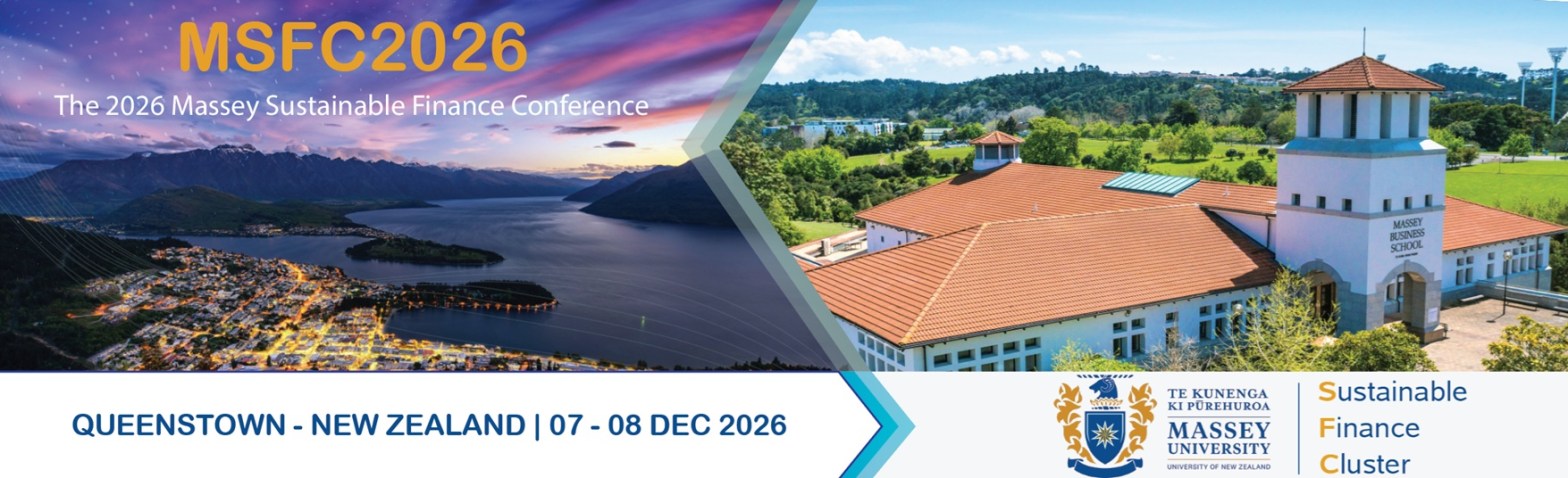
Massey Sustainable Finance Conference 2026

07 December – 08 December 2026 | Queenstown – New Zealand

The conference cordially invites scholars to submit research papers for presentation consideration at the 2026 Massey Sustainable Finance Conference that will take place on 07 Dec – 08 Dec 2026 in Queenstown, New Zealand. All presentations are to be conducted in-person.

This conference is organized by the Massey Sustainable Finance Cluster at School of Accountancy, Economics and FinanceMassey University, aims to bring together academics, practitioners, and policymakers sharing their research findings and discussing current and challenging issues in the crossroad of Finance and Sustainability. The conference is also an ideal occasion for all scholars around the world to present their research, exchange research ideas and experiences, and develop research projects.

The scientific and organizing committees welcome submissions in all topics that link Finance and Sustainability together for presentation at the conference no later than 16 August 2026 (early submission is highly encouraged). Conference and submission platform: https://masseysfc2026.org/

Digital Assets in a Decentralized Financial World

A publication titled “Speed of Adjustment in Digital Assets in a Decentralized Financial World” on Journal of Futures Markets by Hung Do and co-authors in February 2026

Abstract

This paper investigates the stability and co-movement of cryptocurrency assets in Decentralized Finance (DeFi), with a focus on the Speed of Adjustment (SA), the rate at which shocks dissipate, and prices revert to long-run equilibrium. SA provides a critical measure of market efficiency and portfolio allocation in a highly volatile DeFi environment. We extend conventional cointegration analysis by applying a Fractionally Cointegrated Vector Autoregressive framework, which captures slow error corrections. Rolling estimations generate a time-varying series of SA, allowing examination of its evolution and cross-asset spillovers. The results reveal multiple cointegrating relationships, heterogeneous adjustment speeds, and strong contagion effects among DeFi assets. For instance, RPL exhibits rapid yet volatile adjustment, while LDO, BAL, and SNX revert more slowly, reflecting distinct risk-return trade-offs. Spillover analysis highlights high systemic interconnectedness, underscoring challenges for diversification and contagion management. Overall, dynamic SA emerges as a valuable forward-looking indicator of stability in digital asset markets.

Oil Price Uncertainty and Green Innovation

A publication titled “Weathering the storm: How does firm oil price uncertainty exposure impact green innovation in times of geopolitical tensions” on Energy Economics by Jing Chi, Jing Liao and co-authors in January 2026

Abstract

This study examines the impact of oil price uncertainty sensitivity on corporate green innovation, in times of geopolitical tensions. Using manually collected import and export data at the destination country-firm level from China Customs Dataset, we construct the unique measure of firm-level geopolitical tensions of Chinese listed companies received from foreign supply chain partners. Our results reveal that firms with higher exposure to oil price uncertainty are more likely to engage in green innovation. Importantly, geopolitical tensions significantly and positively moderate the relationship between corporate oil price uncertainty exposure and green innovation efforts, with the effect being particularly pronounced in the context of geopolitical tensions originating from customer countries. Further analysis reveals that domestic supply chain alliances and supply chain efficiency mitigate firms’ urgency for green innovation. Finally, we find that the effects of oil price uncertainty and geopolitical tensions on green innovation are more pronounced in firms with higher international exposure, and greater competitive pressures.

Bank expansion and corporate biodiversity risk exposure

A publication titled “Bank expansion and corporate biodiversity risk exposure: Evidence from China” on International Review of Financial Analysis by George Wu and co-authors in January 2026

Abstract

This study examines how bank geographic expansion affects corporate biodiversity risk exposure. Using data from Chinese A-share listed firms from 2006 to 2022, we find that bank expansion significantly increases biodiversity risk. This effect is mainly achieved through weakened bank monitoring, declining green credit allocation, and increased carbon emissions. Heterogeneity tests reveal that the impact is stronger in regions with better environmental quality, in firms with higher business operation uncertainty, and in firm within less-polluting industries. Our findings highlight unintended ecological costs of banking expansion and emphasize the need for coordinated financial and environmental policies.

Does Climate Risk Perception Lead Firm ESG Performance?

A publication titled “From Risk to Sustainable Opportunity: Does Climate Risk Perception Lead Firm ESG Performance?” on Journal of International Financial Management & Accounting by George Wu and co-authors in October 2025

Abstract

Emerging climate risk perception (CRP) has drawn significant attention to its critical role in driving firms’ ESG performance. We construct CRP development at the firm level employing the text analysis method. We explore the causal relationship between CRP and ESG performance using a data set covering listed firms from 2011 to 2022 in China. Our results demonstrate that CRP promotes firm ESG performance, and it is more evident in non-high-tech, non-heavy polluting, and labor-intensive firms. In addition, promoting sustainable green innovation, environmental protection investment, and alleviating information asymmetry are three important channels through which CRP affects ESG performance. Further analysis indicates that CRP strengthens firms’ green value by improving total green factor productivity. Our findings offer actionable insights for firms to achieve green transformation in practice.

ESG fund performance and fund manager trading strategy

A publication titled “ESG fund performance and fund manager trading strategy: Evidence from China” on Global Finance Journal by Liping Zou and co-authors in September 2025

Abstract

This study investigates the performance of environmental, social, and governance (ESG) funds compared with their conventional counterparts in China’s financial market, using quarterly stockholding data from 2018 to 2021. The findings show that ESG funds consistently outperform conventional ones in generating risk-adjusted excess returns. ESG funds also exhibit lower tendencies toward window dressing and maintain longer investment horizons, reflecting their commitment to long-term objectives and reduced focus on short-term gains. Probit model results reveal that fund managers’ personal characteristics—particularly gender and investment style—significantly influence the likelihood of a fund being classified as an ESG fund. Additionally, a trading strategy that mimics ESG principles by investing in high-ESG-rated stocks and divesting from low-rated ones generates positive returns, underscoring the profitability of ESG-based investment strategies. This research provides valuable insights into China’s ESG fund landscape and emphasizes its growing role in promoting sustainable development within the global financial ecosystem.

D&O liability insurance and CSR engagement

A publication titled “Care or fear? The link between D&O liability insurance and CSR engagement: Evidence from China” on Pacific Basin Finance Journal by George Wu and co-authors in September 2025

Abstract

We examine the relationship between firms’ purchasing of Directors’ and Officers’ (D&O) liability insurance and corporate social responsibility (CSR) engagement in China from 2009 to 2019. We find that firms with D&O insurance exhibit significantly higher engagement in CSR activities. The main finding remains significant when we employ 2SLS and PSM-DiD approaches to address potential endogeneity concerns. The mechanism tests reveal that the main finding is driven by the reduction of financial constraints facilitated by D&O insurance, although this positive effect can be weakened by the overinvestment restrictions associated with D&O insurance. Finally, the positive effect of purchasing D&O insurance on firms’ CSR engagement is more pronounced for firms with high risk-taking behaviours, high levels of digital innovation, non-SOEs, and firms located in highly developed regions.

Oil price uncertainty and firm green innovation disclosure

A publication titled “In the heat of the moment, secrets will out: Oil price uncertainty and firm green innovation disclosure” on International Review of Economics & Finance by Jing Chi, Jing Liao and co-authors in March 2025

Abstract

This study investigates the relationship between oil price uncertainty and corporate green innovation disclosure behaviour. Drawing on a textual analysis of annual reports and social responsibility reports of Chinese listed companies, we construct a measure for the intensity of corporate green innovation disclosure. We find a significantly positive relationship between oil price volatility and the level of green innovation disclosure. This relationship remains robust after conducting robustness tests and addressing potential endogeneity. Further analysis reveals that this positive association is moderated by several firm-level factors, including environmental performance, legitimacy demands, and political connections. Additionally, the positive relationship is more pronounced in firms subject to higher regional environmental regulation intensity and market-based green initiatives. Our findings contribute new evidence to corporate sustainable development, demonstrating that energy uncertainty significantly influences information transparency in green innovation disclosure.

Common Volatility in Clean Energy Stocks

A publication titled “Common volatility in clean energy stocks” on Energy Economics by Hung Do and co-authors in August 2025

Abstract

This study investigates common volatility (COVOL) within the clean energy sector, motivated by the sector’s growing importance and its susceptibility to external shocks. For this purpose, we use the COVOL measure developed by Engle and Campos-Martins (2023) to explore sector-wide and sub-sector common volatility, in a range of sub-sectors including renewable energy, energy storage, energy conversion, power conservation, and greener utilities. Our analysis highlights the major events that significantly impact the volatility of clean energy stocks. These include global economic disruptions, geopolitical tension, policy changes and climate-related events. Other key findings reveal the heterogeneous association of sub-sectors’ COVOL to different economic and financial factors, alongside superior explanatory power of COVOL on clean energy risk and return compared to alternative news-based uncertainty measures. These insights emphasize the importance for investors to integrate thorough risk management strategies and for policymakers to create a stable, supportive environment for the clean energy market. The study’s implications extend to enhancing sector resilience and informing strategic investment and policy decisions, contributing to the sustainable growth of clean energy amidst global economic and environmental uncertainties.

Massey Sustainable Finance Conference 2025

31 October – 01 November 2025 | Nanjing – China

The conference cordially invites scholars to submit research papers for presentation consideration at the 2025 Massey Sustainable Finance Conference that will take place on 31 Oct – 01 Nov 2025 in Nanjing, China. All presentations are to be conducted in-person.

This conference is organized by the Massey Sustainable Finance Cluster at School of Accountancy, Economics and FinanceMassey University, in a partnership with the Institute of Digital Economy and Sustainable Development Research, a joint research institute (MIAN Research Institute) between Massey University and Nanjing University of Finance & Economics, aims to bring together academics, practitioners, and policymakers sharing their research findings and discussing current and challenging issues in the crossroad of Finance and Sustainability. The conference is also an ideal occasion for all scholars around the world to present their research, exchange research ideas and experiences, and develop research projects.

The scientific and organizing committees welcome submissions in all topics that link Finance and Sustainability together for presentation at the conference no later than 01st August 2025 (early submission is highly encouraged).